
Houston Head-On Collision Accident Lawyers TX
Home > Houston Car Accident Lawyers > Types of Car Accidents in Houston TX > Houston Head-On Collision Accident Lawyers TX
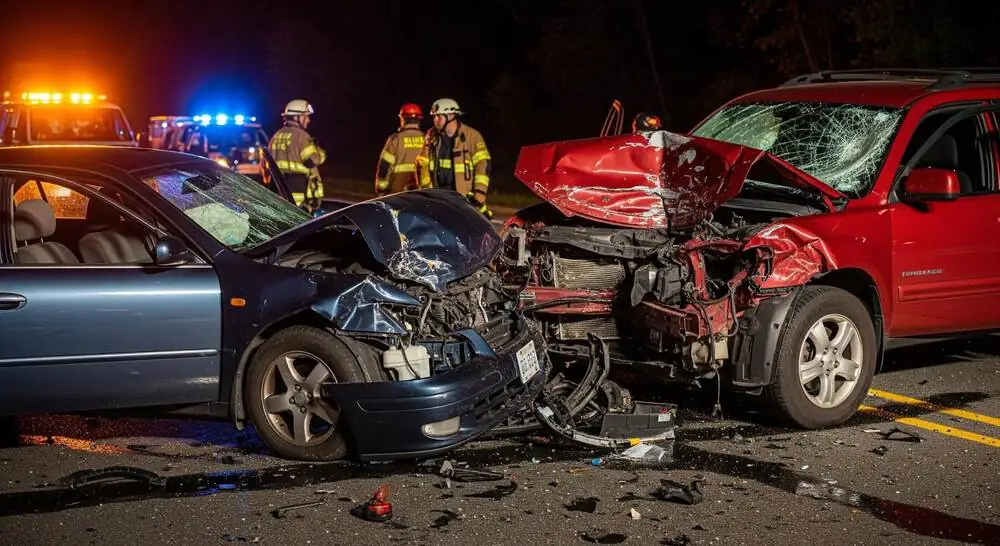
Head-on collisions are among the most catastrophic motor vehicle crashes seen on Houston roads. These violent impacts occur when two vehicles traveling in opposite directions collide front-to-front, often with little or no warning. The result is frequently life-altering, involving severe trauma, long-term disability, or loss of life.
In a city like Houston, where major interstates, two-lane rural roads, and one-way downtown streets intersect with heavy commuter traffic, the conditions for head-on crashes are all too common. Wrong-way entries, lane drift due to distraction or impairment, and unsafe passing on undivided roads all contribute to these high-risk collisions. When these accidents happen, immediate legal support is critical to preserving evidence, identifying fault, and pursuing full compensation for the damages involved.
Call us today at (832) 402-8379 for a free case evaluation with an experienced Houston injury lawyer.
Handling a head-on collision claim is not like managing a minor rear-end accident. These cases often involve severe injuries, disputed liability, and multiple layers of insurance coverage. At Johnson Garcia, we treat head-on crashes with the urgency and depth they require. Our firm has built its reputation on trial-readiness, deep experience in catastrophic injury cases, and a clear understanding of how Houston’s roads and courtrooms shape the path to recovery.
Every head-on collision case we take is built from the start as if it will go to trial. This means we act quickly to preserve black box data, review crash reports, inspect vehicles, and retain expert witnesses. Insurers are more likely to offer fair settlements when they know your case is fully prepared for litigation. Our early work with investigators, reconstruction specialists, and medical professionals creates a foundation that can withstand even the most aggressive defense strategies.
Head-on crashes frequently lead to lifelong medical care, missed income, and permanent lifestyle changes. These high-value claims require strong negotiation power, and that starts with a trial-ready file.
With more than three decades of experience in serious injury litigation, our team understands the medical, legal, and emotional realities that follow a major collision. We have represented victims suffering from spinal cord damage, traumatic brain injuries, and orthopedic trauma requiring multiple surgeries. We have also handled wrongful death claims brought by surviving family members seeking justice and financial stability after a tragic loss.
We do not rely on assumptions or formulas when evaluating damages. We work directly with physicians, economists, and life care planners to document what you need now and what you will need in the future.
Being based in Houston gives us an edge when it comes to understanding how and where these collisions happen. We know the dangerous intersections, the rural roads without center barriers, and the freeway access points where wrong-way entries are more common. This local knowledge helps us conduct faster investigations and explain the crash context clearly to insurance companies or juries.
We are also familiar with the local courts and judges, including how they handle complex injury litigation. That familiarity helps us tailor each case to the expectations of the court, from how we present expert evidence to how we support damages claims.
Our attorneys began their careers defending insurance companies. That experience allows us to predict how the other side will approach your case. In head-on crashes, insurers may argue comparative fault, downplay the extent of injury, or challenge whether your condition is truly related to the crash. We know how to anticipate those tactics and respond with medical records, expert reports, and legal arguments that protect your right to full compensation.
When your case is being evaluated by a claims adjuster, we make sure the file tells the full story—not just of the crash, but of how it has affected your life and what it will take to recover.
Unlike many other crash types, head-on collisions involve the full momentum of both vehicles. This creates a force of impact that far exceeds what is seen in a sideswipe or rear-end crash. The result is a violent energy transfer that can destroy vehicle structures, bypass safety systems, and cause extensive injuries even at moderate speeds.
When two vehicles collide head-on, their speeds combine to create a much higher impact force. For example, if both vehicles are traveling at 40 miles per hour, the collision mimics the impact of hitting a solid wall at 80 miles per hour. This level of force often leads to complete vehicle destruction, intrusion into the passenger cabin, and multiple points of injury to occupants.
Seatbelts and airbags can only do so much to absorb this level of energy. Victims are frequently found with multiple injuries to the head, chest, spine, and lower extremities.
In severe head-on collisions, the engine compartment may be pushed back into the passenger space, crushing legs, pelvis, and chest areas. Roofs may collapse, windshields may shatter, and doors may become jammed, making it difficult for first responders to reach injured occupants.
This level of intrusion can cause compound fractures, internal injuries, and entrapment-related complications. These injuries often require immediate surgery and intensive trauma care, followed by months of rehabilitation.
Many head-on crashes occur on rural highways outside Houston, where help may not arrive quickly. Victims may remain trapped or unattended for long periods, increasing the risk of complications such as blood loss or organ damage. In these cases, documenting the timeline and medical response is critical to understanding the full impact of the crash.
We work with medical experts to reconstruct the treatment sequence and evaluate how delays may have worsened injuries. This information becomes part of the damages calculation, especially in wrongful death or permanent disability claims.
Victims of head-on collisions often suffer:
Each of these injuries may require specialized care and can have long-term effects on mobility, cognition, and daily functioning. We make sure these consequences are fully reflected in your claim.
Houston’s roadway network includes a mix of urban grid systems, suburban arterials, and rural highways. Each presents different risks when it comes to head-on collisions. Understanding where these crashes happen helps direct our investigations and supports the argument that driver negligence, not road design, caused the crash.
Roads like FM 1960, FM 2920, and parts of Highway 6 have long stretches without a center barrier. When a driver crosses the center line, whether due to distraction, fatigue, or misjudgment, a head-on crash becomes likely. These roads also carry high speeds and have limited shoulder space, leaving little room for evasive action.
We examine skid marks, lane width, and road curvature to evaluate whether the crash could have been avoided and to determine how the collision occurred.
Wrong-way entries onto one-way streets are common in dense urban areas, especially at night or in bad weather. Distracted or impaired drivers may turn the wrong way and cause a head-on crash with another vehicle lawfully traveling in the opposite direction.
These crashes often involve commercial corridors, entertainment districts, or poorly marked intersections. Our investigation focuses on signage, lighting, and road layout to determine how the wrong-way entry occurred.
Freeway ramps in Houston are a frequent site of wrong-way entry accidents. Drivers who are intoxicated, confused, or relying on outdated GPS directions may enter an off-ramp thinking it is an on-ramp, setting up a head-on collision at freeway speed.
We use traffic camera footage, 911 records, and road design evaluations to determine where the error occurred and whether signage or visibility contributed.
Low lighting and inadequate road markings increase the risk of crossing the center line or turning onto the wrong road. This is particularly common in suburban neighborhoods, warehouse districts, and construction zones.
We document lighting conditions, signage placement, and any temporary detours that may have played a role in the crash.
Head-on collisions are typically the result of a clear driving error. Unlike rear-end crashes, which may be caused by traffic flow or inattention, head-on crashes often involve gross negligence or reckless behavior. Identifying the cause of the crash is central to proving fault and recovering compensation.
Drivers who look away from the road, even for a few seconds, can drift into the oncoming lane. This is especially dangerous on undivided roads or curves with poor visibility. Texting, reaching for items, or interacting with in-car systems are common distractions that lead to lane departures.
Drowsy drivers are less responsive, more prone to error, and more likely to fall asleep entirely. When this happens on a rural highway or late at night, the result is often a high-speed, head-on impact with an unsuspecting driver.
We examine the timeline, trip length, and the at-fault driver’s activity prior to the crash to evaluate whether fatigue was a factor.
Impairment affects judgment, motor control, and vision. Drunk drivers are notorious for entering freeways in the wrong direction or drifting into other lanes. These crashes often occur at night or on weekends, when alcohol use is more common.
We obtain toxicology reports, arrest records, and witness statements to establish impairment and pursue punitive damages when appropriate.
Drivers who attempt to pass without adequate visibility or space may collide head-on with oncoming vehicles. This is particularly dangerous on two-lane roads with hills, curves, or limited shoulder room.
We analyze road conditions, signage, and vehicle positioning to determine whether an illegal or unsafe pass caused the crash.
Determining fault in a head-on collision is a critical step in securing compensation. These crashes often result in severe injuries or fatalities, which means the at-fault driver’s insurance company will look for any opportunity to avoid full responsibility. Early investigation is essential, especially in cases where there are no independent witnesses or where both drivers claim to have been in the correct lane.
The most direct way to prove fault is by showing that one driver entered the wrong lane or traveled in the wrong direction. In Texas, doing so violates multiple traffic laws and creates a presumption of negligence. We begin by gathering police reports, crash scene measurements, and any available video to document which vehicle crossed into oncoming traffic.
This evidence forms the foundation of your case and allows us to build a clear, factual narrative about how the collision occurred.
Eyewitness accounts can help clarify what happened in the seconds before a head-on crash. Bystanders, passengers, or drivers in nearby vehicles may have seen the other car drifting, swerving, or entering the road from the wrong direction. Their statements can reinforce physical evidence and disprove claims of shared fault.
In more complex cases, we work with crash reconstruction experts. These professionals use vehicle damage, speed analysis, and scene measurements to create a simulation of the collision. Their reports are especially helpful when the insurance company disputes liability or when a jury must evaluate conflicting stories.
The location of skid marks, debris, and final vehicle placement can tell investigators a great deal about how a head-on crash unfolded. We photograph and map the scene immediately when possible, or work with police and tow yard records if the scene has already been cleared.
For example, if both vehicles are located entirely in one lane, that may suggest the other driver was responsible for the lane departure. If debris is scattered across multiple lanes, that could indicate high-speed impact or attempted evasive maneuvers. We use this data to support your version of events and counter any efforts to place blame unfairly.
Traffic cameras, security systems, and dashboard cameras frequently capture head-on collisions or the moments leading up to them. We identify and request this footage as early as possible, before it is erased or overwritten. These videos can show erratic driving, wrong-way entries, or clear violations of traffic signals and right-of-way.
Dashcam evidence is particularly powerful because it shows the crash from your perspective. When available, it helps us prove you were driving responsibly and that the collision was caused entirely by the other driver’s error.
Serious injury cases require careful planning, expert coordination, and thorough preparation. At Johnson Garcia, we do not wait for insurers to act. From the moment you contact us, we begin gathering the facts and building a legal strategy designed to deliver meaningful results.
Preserving evidence is critical, especially in cases involving permanent injuries or fatalities. We photograph the vehicles, secure scene documentation, and request records from law enforcement, medical providers, and insurance companies. We also consult with engineers, forensic analysts, and vehicle safety specialists to evaluate crash mechanics and injury causation.
By working with experts early, we ensure that your claim reflects both the technical details of the collision and the real-world consequences it created.
Your injuries are not just a list of diagnoses—they are a roadmap of what your recovery will look like. We work closely with orthopedic surgeons, neurologists, and rehabilitation specialists to understand your future care needs. If you require surgery, assistive devices, or long-term therapy, we make sure those costs are included in your case valuation.
This collaboration also allows us to present your injuries in a way that juries and insurance adjusters understand. We focus on how your condition affects your work, your family life, and your independence.
We evaluate both economic and non-economic damages in every head-on collision case. That includes not only current medical bills and lost wages, but also future expenses, reduced earning capacity, and quality of life changes. When appropriate, we bring in economists and vocational experts to help quantify these losses.
Our goal is to present a complete, well-supported claim that reflects the full scope of what you have endured—and what you will need moving forward.
Not every case settles. When the insurance company refuses to make a fair offer, we are fully prepared to take your case to trial. That preparation begins on day one and continues throughout the process. We prepare you for depositions, build your testimony around your lived experience, and ensure that expert witnesses are available to support your case in court.
Our trial experience gives us leverage in negotiation and confidence in the courtroom. We never advise clients to settle just to avoid litigation if the offer does not reflect what the case is truly worth.
When a loved one is killed in a head-on collision, the legal and emotional aftermath can be overwhelming. Families are left to manage funeral expenses, loss of income, and a future without someone they depended on. In these moments, knowing your legal options can provide a path toward justice and financial stability.
Texas law allows certain family members to file a wrongful death lawsuit. This typically includes spouses, children (including adopted children), and parents of the deceased. If none of these individuals file within a designated period, the estate’s representative may bring a claim on behalf of the beneficiaries.
We help families understand who is eligible, how the process works, and what types of recovery are available under Texas law.
Wrongful death compensation can include:
These damages are designed to compensate both the financial and personal losses suffered by the surviving family. We work to document these impacts and present them clearly to insurers or juries.
Even in fatal crashes, insurers may attempt to avoid responsibility. They may claim the victim was at fault or that there is not enough evidence to support the claim. We act quickly to preserve crash data, obtain autopsy reports, and interview witnesses. This evidence is essential to establishing fault and proving the full extent of the harm caused.
We also hold drivers accountable through civil court when criminal charges are not filed or do not reflect the full weight of what occurred.
Wrongful death cases require sensitivity, strategy, and persistence. Our firm has represented families in some of the most difficult cases imaginable, and we understand the unique pressures that come with grieving while pursuing justice. We handle the legal side so you can focus on healing and honoring your loved one’s legacy.
In a head-on collision case, the goal is not only to recover your immediate expenses but also to address the long-term effects of the crash. These damages fall into several categories, each of which requires careful documentation and legal advocacy.
We seek compensation for all accident-related medical care, including emergency transport, surgery, hospitalization, follow-up care, and rehabilitation. If your injuries require future treatment or monitoring, those costs are also included in the claim.
If you are unable to work because of your injuries—or if your capacity to earn has been reduced—we calculate those losses based on employment history, industry standards, and expert analysis. This includes time missed from work, career changes, or early retirement due to disability.
The physical and psychological toll of a head-on crash can be overwhelming. We pursue damages for pain, trauma, anxiety, and loss of enjoyment of life. These damages recognize the human cost of what you have endured and how your life has changed.
We recover the cost of repairing or replacing your vehicle, as well as any other personal property damaged in the crash. This includes rental vehicle costs and any loss of use during the repair period.
When a driver’s actions are especially reckless—such as driving while intoxicated or entering a freeway in the wrong direction—punitive damages may be available. These are designed to punish the at-fault driver and deter similar conduct in the future. We pursue these damages when supported by the facts and applicable law.
At Johnson Garcia, we understand the devastation that follows a head-on collision. These crashes are not just high-impact—they are life-changing. That is why we approach every case with urgency, strategy, and a commitment to seeing it through.
With more than 35 years of experience, our team is equipped to investigate complex crashes, build strong legal claims, and take cases to trial when needed. Whether your case involves spinal cord trauma, wrongful death, or long-term disability, we are ready to help you pursue justice and financial recovery.
If you or a loved one were injured in a head-on crash, contact Johnson Garcia today to speak with Houston head-on collision lawyers who are ready to advocate for your future.
START YOUR JOURNEY TOWARDS JUSTICE
START YOUR JOURNEY TOWARDS JUSTICE
 CALL NOW